

ARM REST CENTER CONSOLE REFREGERATION BASE CONCEPT DESIGN
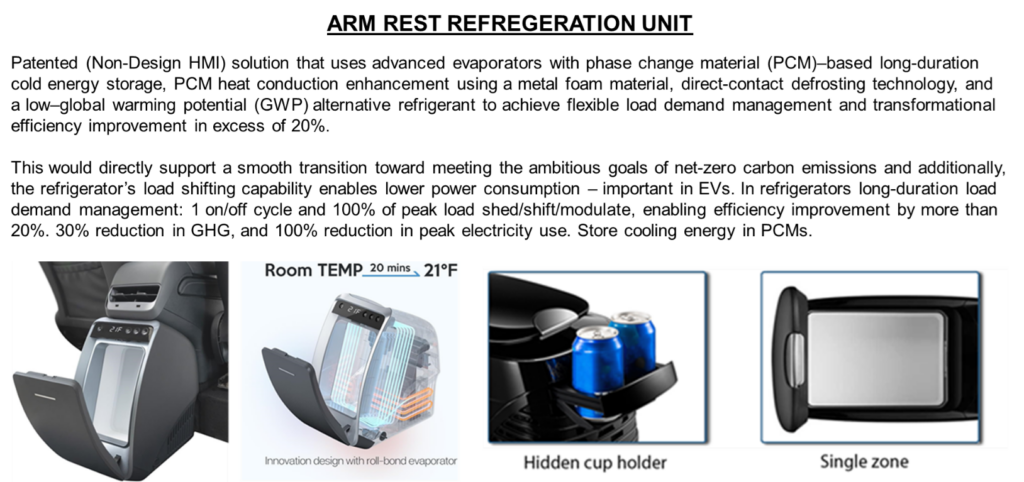
Patented (Non-Design HMI) solution that uses advanced evaporators with phase change material (PCM)–based long-duration cold energy storage, PCM heat conduction enhancement using a metal foam material, direct-contact defrosting technology, and a low–global warming potential (GWP) alternative refrigerant to achieve flexible load demand management and transformational efficiency improvement in excess of 20%.
This would directly support a smooth transition toward meeting the ambitious goals of net-zero carbon emissions and additionally, the refrigerator’s load shifting capability enables lower power consumption – important in EVs. In refrigerators long-duration load demand management: 1 on/off cycle and 100% of peak load shed/shift/modulate, enabling efficiency improvement by more than 20%. 30% reduction in GHG, and 100% reduction in peak electricity use. Store cooling energy in PCMs.
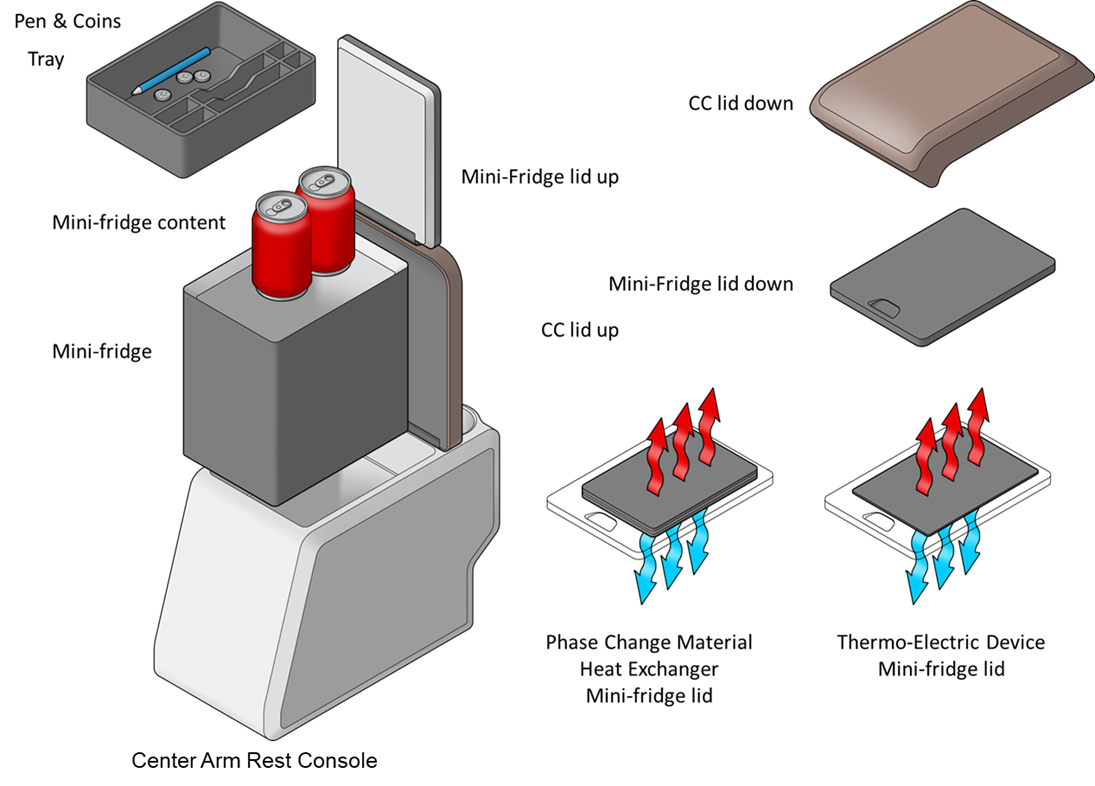
Target Piece Cost: $15.50 to $45 based on volumes
Timing Production Intent Design: 6-Weeks.
Timing Production Intent Prototype: + 8-Weeks
Production Assembly & Validation: + 20-Weeks
PCM MATERIALS – IN VEHICLE REFREGERATION AND HEATING TEMP MAINTAINANCE
Phase change materials (PCM) can store latent and sensible energy in the form of light, heat, electricity or hydrogen and exhibit reversibility. A PCM can store and release large amounts of heat/energy while maintaining a constant temperature unlike conventional solutions.
Phase change materials are engineered to change their phase (solid to liquid or vice versa) at a specific temperature and one should look at the following three factors to qualify a PCM.
- High thermal storage capacity in the form of latent heat (200KJ/Kg or above)
- Constant temperature maintenance during the release of stored energy
- Guaranteed repeatability in performance for over 3000 times
The benefits of the above features are precise temperature control (allowing not more than +/- 1°C of error); longer duration of retention period (up to 18 hours due to high latent heat), and reduction in the overall weight of the freezer due to high energy storage to weight ratio of the PCMs.
Click & Refer Business Standard.
The PCM is designed to melt at a specific temperature range, which is typically within the operating temperature range of the evaporator. When the compressor is turned off, the PCM absorbs heat from the cabinet of the refrigerator and melts which helps to keep the refrigerator cool.
The technology developed by the USA’s Oak Ridge National Laboratory uses advanced evaporators with PCMs installed in each compartment for cold energy storage. Researchers applied porous metals, direct-contact defrosting technology and a refrigerant with low global warming potential to enhance performance and minimize environmental impact. Email info@coolingpost.com for more information.
PCMs store and release energy, much like a battery, as they change phases (melt/solidify). Click Temprecision International to view complete range of PCM to support temperatures from -21C to 22C.
Advantages of PCM-based refrigeration:
- Improved Temperature Stability: PCMs help to minimize temperature fluctuations, which is crucial for maintaining the quality and safety of temperature-sensitive items like pharmaceuticals, vaccines, and food.
- Energy Efficiency: PCM-based systems can reduce the need for constant active refrigeration, leading to lower energy consumption and reduced reliance on electricity.
- Reduced reliance on electricity: PCM-based systems can operate passively, meaning they don’t require constant power input, making them suitable for remote locations or during power outages.
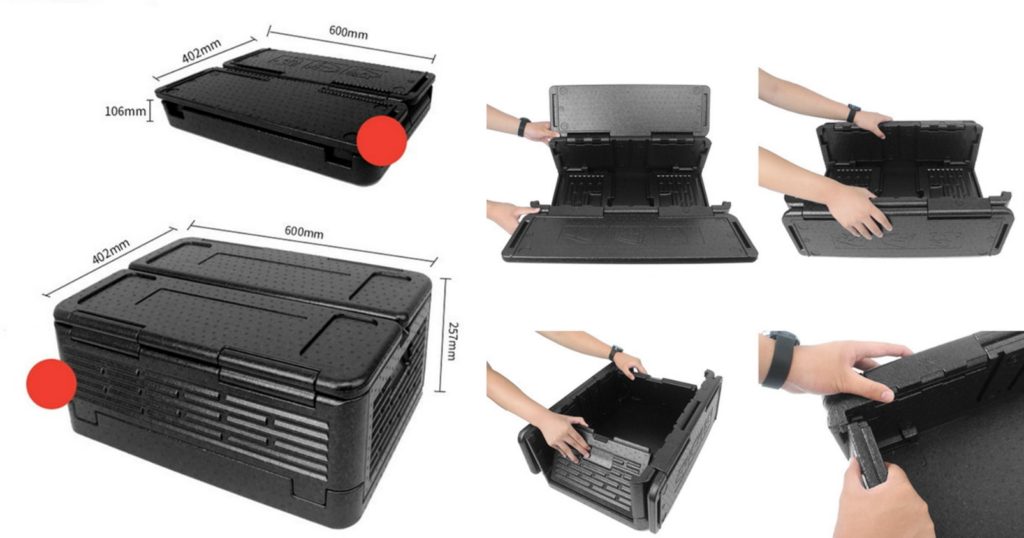
Phase change Materials (PCMs) are formulations that enable the storage of energy in thermal form i.e., hot or cold energy. These specific formulations freeze and melt at specific temperatures, thereby maintaining precise temperatures in insulated boxes/containers without any external energy. PCM technology effectively replaces traditional reefers, offering more options for temperature control in ambient trucks, 3-wheelers, or bikes.
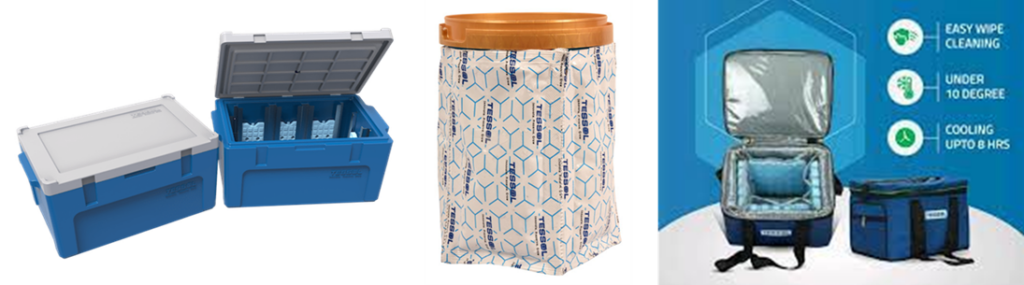
IndiWRAP is a way to deliver chilled and frozen food cost-effectively. IndiWRAP, powered by their very own ‘Phase Change Material’ technology, is a lightweight encapsulation and uses a special version of the PCM that is designed to be used for a few freezing/melting cycles. This makes the solution cost-effective while ensuring your temperature performance is not compromised.
Tessol has built a range of Insulated carriers – Rotomolded LLDPE-based boxes and insulated bags with food-grade lining combined with specially designed PCM cartridges / IndiWRAP to replicate a specific temperature performance for the customer. Click https://tessol.in/cold-chain-for-food/ to review.
For more information for directed applications email designhmi@gmail.com.
